
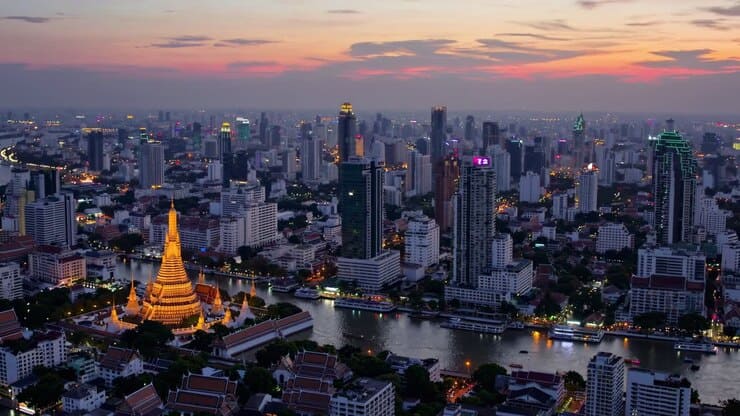
Bangkok, Thailand.
Overview & Benefits
Thailand's digital nomad route is officially the Destination Thailand Visa, or DTV. It is designed for foreigners on a tourist-style long stay who work remotely, plus certain approved soft-power activities such as Muay Thai, cooking, seminars, and medical treatment.
The appeal is easy to see. The visa is multiple entry, lasts 5 years, and gives you up to 180 days per entry with one in-country extension. That makes it much more flexible than a standard tourist stay, especially if you want to base yourself in Bangkok, Chiang Mai, Phuket, or Koh Samui without constantly resetting your status.
The trade-off is that Thailand still expects a real file. The core proof is simple, but embassies can be picky about your current location, your remote-work evidence, and your money trail. If the paperwork is thin, expect delays or a request for more documents.
The main financial benchmark is:
- Main applicant: 500,000 THB in bank statements
Some embassies also ask for extra supporting evidence such as salary slips, employment certificates, company registration, or a professional portfolio. That is why the strongest files are usually the boring ones: clear, consistent, and easy to verify.
From a tax angle, the DTV does not give you a special tax holiday. Thailand generally treats you as a tax resident once you spend 180 days or more in a tax year. Residents are taxed on Thai-source income and on foreign-source income brought into Thailand, and current Revenue Department guidance says foreign income earned from 1 January 2024 onward can be taxable when remitted into Thailand in the same or a later tax year.
The usual refusal reasons are practical, not exotic: the balance is too low, the documents do not match the track, the passport is close to expiry, the embassy wants local-residence proof and you do not have it, or the remote-work story is too vague.
5-year multiple-entry validity180 days per entry, extendable onceFamily members can apply too
Best for
This visa structure provides the highest ROI for these specific profiles:
Remote employeesFreelancersFoundersLong-stay digital nomads
Main Requirements
To qualify for the Destination Thailand Visa (DTV), you must meet the following criteria:
- The official name is Destination Thailand Visa (DTV); "digital nomad visa" is the common shorthand for the workcation category.
- You need a passport valid for at least 6 months from travel date and a recent photo.
- You must show at least 500,000 THB in bank statements for the last 3 months. Some embassies may ask for extra income proof such as salary slips.
- For the workcation track, you generally need a foreign employment contract or certificate, or a professional portfolio showing remote worker, freelancer, or foreign talent status.
- The visa is aimed at remote work and approved soft-power activities, not ordinary local employment in Thailand.
- Spouses and children under 20 can qualify as dependents.
- Applications are handled through Thai embassies or consulates and the Thai e-Visa system, and embassies can ask for interviews or extra documents.
- Documents should be prepared in English or Thai.
Reality Check: Rejections & Delays
Real Approval Difficulty
Medium. The rule set is simple, but embassies are strict about proof of funds, location, and activity-specific documents.
Actual Timeline
Official guidance says the process takes about 4 weeks, and longer if the file is incomplete.
Common Rejection Reasons
- The bank balance is below 500,000 THB or the statement period is wrong.
- The applicant cannot prove remote work or the approved activity.
- The passport is too close to expiry.
- Supporting documents are incomplete, untranslated, or inconsistent.
- The embassy asks for proof of current location in its jurisdiction and the applicant does not have it.
Biggest Downside
The biggest friction is inconsistency between embassies: one office may want salary slips or company registration, another may focus on bank balance and the remote-work proof.
How to Apply (Step by Step)
1
Pick the right DTV track
Use the workcation track if you are a remote worker, freelancer, or founder. Use the soft-power track if you are coming for an approved activity like Muay Thai, cooking, or medical treatment.
2
Gather the evidence
Prepare your passport, photo, bank statements, and the documents that match your track, plus any proof of your current location if the embassy wants it.
3
Submit the e-Visa application
Apply through the relevant Thai embassy or consulate, or the Thai e-Visa system where available. Be ready for extra questions or an interview.
4
Enter and extend if needed
The initial stay is up to 180 days. If you need more time in that entry, you can request the one-time extension with immigration.
Tax & Banking Reality
Can this lead to tax residency?
Thailand generally treats you as tax resident if you spend 180 days or more in a tax year. The Revenue Department says residents are taxed on Thai-source income and on foreign-source income brought into Thailand. Current guidance also says foreign income earned from 1 January 2024 onward can be taxable for residents when remitted into Thailand in the same or a later tax year. The DTV does not create a special nomad tax regime.
Do banks accept this visa?
Thai banks are branch-specific. Expect passport, visa approval, and some form of local address evidence. It is usually easier to open an account after arrival than before.
Frequently asked questions
Is the DTV the official digital nomad visa for Thailand?
Yes. The official name is Destination Thailand Visa, and the workcation track is the digital nomad route.
Can I extend my stay beyond 180 days?
Yes. The official guidance says each entry can be extended once in Thailand for up to another 180 days.
Can my spouse and children apply with me?
Yes. Spouses and children under 20 can apply as dependents.
Do I need a monthly income of 500,000 THB?
No. The official documents focus on bank balance proof, not a monthly income threshold, though some embassies may still ask for salary slips or similar evidence.