
Updated for 2026. Informational only; get local tax advice before moving.
What tax residency means
Tax residency decides which country can tax you as a resident. In most countries, residents are taxed on worldwide income: salary, dividends, capital gains, business profits, rental income, crypto gains, pensions, and sometimes foreign trusts or companies. Non-residents are usually taxed only on local-source income, such as local employment income or property income.
It is separate from citizenship and immigration status. You can hold a passport from one country, live legally in another, and still be treated as tax resident somewhere else if your facts point there.
For founders, the personal move and the company move are connected. If you run a Wyoming LLC, Estonian OÜ, Dubai FZCO, or Georgia LLC, your new country may ask where the company is actually managed, where contracts are signed, and whether local activity creates taxable presence.
The founder relocation process
1. Choose the tax outcome, not just the country
Map the taxes that actually hit you: salary, dividends, capital gains, retained company profits, crypto gains, exit tax, wealth tax, inheritance tax, and social security. A 0% personal income tax country can still be bad if your company becomes taxable there.
2. Build a defensible arrival file
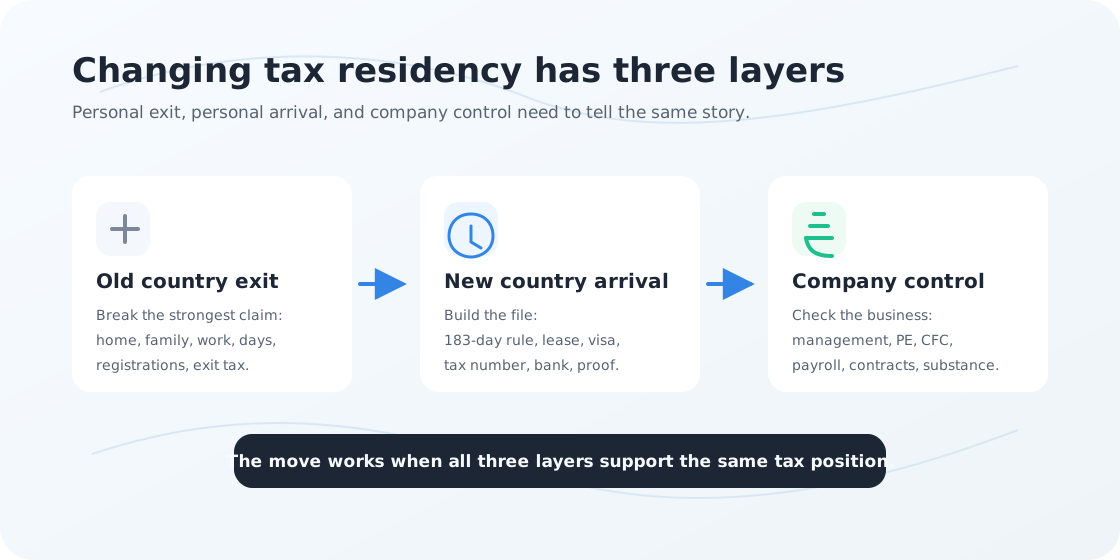
Before you claim new tax residency, collect hard evidence: lease, residence permit, utility bills, local bank account, health insurance, entry records, local tax number, and proof that you actually manage your life from the new country.
3. Break the old country's strongest claim
Identify why your old country could still call you resident: home available, spouse or children there, board meetings there, local employment, local clients, habitual visits, or company management. Then remove or document those facts.
4. Re-check your company after the move
A personal move can change where your company is effectively managed. Review permanent establishment, management-and-control tests, CFC rules, substance, payroll, contracts, and where strategic decisions are made.
Important: the move date should be planned before you relocate, especially if you own a company, crypto, investment portfolio, real estate, or unrealized gains.
The 180-day rule is usually the 183-day rule
The phrase "180-day rule" is common, but it is imprecise. Many countries use 183 days because it is just over half of a normal year. Spending 183 days in a country often makes you tax resident there, but spending fewer than 183 days does not always keep you non-resident.
Countries may also look at whether you have a permanent home, where your spouse or children live, where you work, where your company is managed, where your main bank accounts and investments are, and where you habitually return. Day counting is only one part of the test.
How day-count rules differ
Common rule183 days or more in the country usually creates tax residence.Do not assume it is exactly 180 days. In many tax laws the operative threshold is 183 days.
United Kingdom183 days or more in the UK tax year is an automatic UK residence test.The UK also has automatic overseas tests, home tests, full-time work tests, and sufficient-ties rules.
United StatesThe substantial presence test uses 31 days in the current year plus a weighted 183-day formula over three years.US citizens and green-card holders have separate worldwide tax rules, so simply moving abroad may not end US tax filing obligations.
United Arab EmiratesIndividuals can qualify through 183 days in a 12-month period, or 90 days with extra conditions.A UAE residence visa helps, but tax residency certificate requirements and treaty use still need careful checking.
GeorgiaGeorgia can be attractive for founders, but residence, source rules, and company setup still need separate analysis.Do not confuse an easy stay or company registration with automatic personal tax optimization.
How to actually change tax residency
A clean move has three sides: arrival, departure, and company control. Arrival means meeting the new country's residence test. Departure means your old country can no longer reasonably treat you as resident. Company control means the business does not accidentally move with your laptop.
If you move to the UAE, Georgia, Paraguay, Panama, or Singapore, the headline tax rate is only the start. The real question is whether your old country still sees your home, family, board control, or economic life there.
Count days before moving and keep travel records, boarding passes, lease dates, utility bills, residence permits, and tax registrations.
Check whether your old country has an exit tax, deemed disposal rule, trailing tax rule, or minimum non-residence period.
Establish a real home in the new country: lease or purchase, utilities, local phone, local health insurance, and bank account.
Move your centre of life where possible: spouse, children, main work location, company management, investments, memberships, and doctors.
Document where company decisions are made: board minutes, founder location, contract signing, bank approvals, and key commercial negotiations.
File departure or arrival forms when required. Some countries require formal deregistration; others decide later based on facts.
Review companies, trusts, crypto holdings, securities, pensions, and stock options before the move date.
What happens to your company when you move?
Your company does not automatically change tax residence because you personally move. But if the founder is the real decision-maker, the company can create tax exposure in the new country. This is especially relevant for solo founders, consultants, agencies, SaaS owners, crypto traders, and holding-company structures.
The main risks are permanent establishment, management and control, and controlled foreign company rules. Permanent establishment asks whether the company has enough business presence in the new country. Management and control asks where strategic decisions are actually made. CFC rules can tax foreign company profits directly to you even before dividends are paid.
Common structures need different checks: Wyoming LLCs can be simple for US formation but confusing abroad because some countries do not treat LLC transparency the same way. Estonian OÜs are useful for EU administration, but Estonia e-Residency does not decide your personal tax residency. Dubai FZCOs and Hong Kong limited companies still need substance, banking, source-of-income, and management-location analysis.
Two common founder scenarios
UK founder moving to the UAE with a Wyoming LLC
The personal move is only one layer. The founder should check the UK statutory residence test, possible split-year treatment, UK exit implications, and whether the Wyoming LLC is effectively managed from the UAE. The clean file has UAE residence evidence, travel records, documented company decision-making, and a clear position on how LLC profits are taxed personally.
Remote founder moving to Georgia with an Estonian OÜ
Georgia can be attractive, but Estonian OÜ administration does not decide personal tax residence. The founder should check local residence rules, where the company is managed, whether retained profits are taxed personally, and whether local work creates permanent establishment risk.
Visas and tax residency
A visa is an immigration document. Tax residency is a tax-law conclusion. You normally need both: legal permission to live in the new country and enough facts to be treated as resident there.
For example, a residence visa in the UAE can support a relocation file, but you still need to check UAE tax residency certificate rules, treaty use, day count, and whether your company should be local, offshore, or left where it is.
Common visa routes
Digital nomad visaRemote workers and founders who earn outside the host country.Some visas attract residents without automatically giving a special tax regime.
Work or self-employment visaPeople moving operations, employment, or freelance activity.Local payroll, social security, and permanent establishment issues can appear quickly.
Investor or entrepreneur visaPeople investing, starting a company, or buying qualifying assets.The investment route may create local tax filings even before personal tax residence is clear.
Retirement or passive income visaPeople with pensions, dividends, rental income, or investment income.Foreign pension, wealth tax, inheritance tax, and remittance rules matter more than headline income tax.
What can go wrong
The biggest mistake is treating tax residency as a travel hack. Tax authorities look for substance. If you keep your old home available, keep your family there, run your company from there, and visit frequently, you may still be resident even if you spend more time abroad.
Other risks include exit taxes on unrealized gains, social security contributions, controlled foreign company rules, permanent establishment exposure for your company, split-year filing errors, and treaty positions that are weaker than expected.
Common mistake: you leave a high-tax country, keep managing the same company from anywhere, keep the same contracts and bank setup, then assume a low-tax residence page solves it. It does not. Compare personal tax pages such as UK income tax, UAE income tax, and Georgia corporate tax alongside the company structure.
Next checks
After you understand the residency move, compare the country and company layers together.
Frequently asked questions
People often say 180 days, but many tax laws use 183 days. The number is only a shortcut. You must check the exact statute, day-count method, and tax year for each country.
Sources
Cross-check your country before acting. Useful primary references include the UK residence guidance, IRS substantial presence test, and UAE Cabinet Decision No. 85 of 2022.